In our previous post we wrote about the changes that Magento 2 brought to the backend and frontend interface, and now you can explore them with your own eyes in our Magento 2 demo store.
The frontend of each store largely depends on the implemented theme, configuration and integrated extensions and can be surprisingly different from the default view. In our demo store we tried to mainly keep unchanged the default user interface to let you have an idea of the starting point you approach right after the installation.
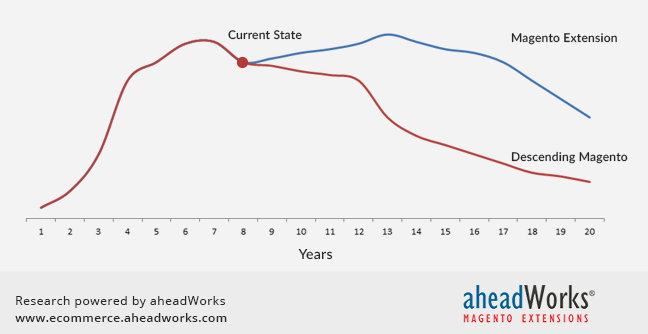
Through the years of the Magento market share investigation, we collected a significant data amount, which is interesting to be interpreted as a trend. We believe that this data is able to explain the way Magento is now going and its farther perspectives.
By 2012 and the start of our studies Magento gained its greatest popularity, according to Google Trends. So, our first blog post on the topic indicated that Magento CE had almost 25% of the market share. Since then, its share fluctuates around this mark rising or descending due to the specific circumstances of each investigation, but didn’t change considerably.
The UK has the biggest online market share worldwide in 2014 – 13.5%, and expected to reach 15.2% in 2015. (Source: www.retailresearch.org) And, Magento is one of most popular shopping cart technologies there.
British online merchants widely and effectively use Magento Community and Enterprise editions and willingly share their sophisticated ecommerce experience.
Selling internationally is an ambitious aim and difficult task simultaneously. On the one hand you can enter the vast market and skyrocket your sales, but on the other hand you will have to enter terra incognita for your business full of new requirements and local regulations.
Launching international sales requires a lot of time, specific knowledge, and necessary software. The whole process, since payments to shipping, is to be organized almost from scratch due to the specifics of global trading.
Selling online becomes more and more complicated, and it is not always about the sophisticated and ruthless competition. Often, it’s about the lack of unique shopping experience and fun.
In most cases, offline shopping is entertainment and customers want to have fun online, as well. Digital games are the greatest gain of the virtual world and their power of engagement is not yet completely used in ecommerce and gamification is one of the ways to leverage their impact on sales.
The ecommerce software market is changing drastically clashing and stirring leaders and newcomers. Some platforms make tremendous spurts and leave us behind guessing, if it is just an accidental happening or rising of the new star.
WooCommerce is that black horse, which made us stand still in wonder, but really curious, if it has anything to do with ecommerce or more about blogging. In this post we’ll try to find out the differences of stores made on Magento and WooCommerce and their characteristics as possible competitors.
Which is better, to have 0 or $10.000 at the beginning of each month? Surely, no one will choose the first option when it comes to real money.
Starting each new business month you suppose to reach a certain sales volume and can estimate the revenue you will apparently obtain, but it is still just your assumption. And, you will certainly be more confident and surefooted, if you firmly know that this revenue is assured to you by your customers. It is really possible within the recurring revenue business model.
This year Imagine 2015 was held on the eve of Magento 2 release and a great part of the conference content was devoted to its new features and functionality.
Magento 2 made three sessions at Imagine 2015 and was the major topic of the first conference day.
Several months ago new Magento Forum was presented to the community. What are the perspectives of the new communication platform and how does it reflect the expectations of multiple users and developers?
To be honest, each of us was sure that the old forum could no longer exist as it was and needed some fundamental changes. And, most likely, the decision to replace it with something totally new was right in those circumstances. As most of the community, we believe that it was a great idea and today we enjoy the result.
Magento is one of most popular open source ecommerce platforms and offers many benefits to its users, including a free version and developed community of store owners, extension and theme providers, and Magento experts.
It is truly powerful, sophisticated and efficient without any doubts, but some perfectionists (or dreamers) certainly wonder about the possibility to launch a Magento store without any expenses. Let’s see how can we fulfill this task or at least come close to the solution.